 Try the demo
Experience the game using play money — no registration needed.
Play Tower Rush online: demo, bonuses and real money
Three calls decide how a session of Tower Rush unfolds, and each one is yours to make before the first level appears. This presentation sets them out one by one, from fixing a wager to choosing a banking point and closing a session, before covering the bonus levels, the published return range, free practice, mobile access and the safeguards that keep play sensible.
- Game type
- Crash-style game
- Wager range
- 0.1 - 100
- RTP
- 96.25–97.5%
- Developer
- Galaxsys
- Max payout
- 100×
- Variance
- Medium-High
★ User feedback
- Sarah L.
J'adore la façon dont chaque décision dans Tower Rush semble cruciale. L'excitation d'attendre pour encaisser me tient en haleine.
- Amit K.
Tower Rush vous accroche vraiment ! Le mélange de stratégie et de rapidité est exaltant à chaque session.
- Lucy G.
C'est un jeu amusant, mais j'ai eu des moments frustrants lorsque la tour s'effondre juste avant que je n'encaisse.
Comparison with similar games
- Tower RushGalaxsysRTP 96.25–97.5%
- CrashBGamingRTP 97%
- SpacemanPragmatic PlayRTP 96.5%
- PlinkoSpribeRTP 97%
Summary: Tower Rush is a crash game developed by Galaxsys, featuring an engaging gameplay mechanism where players wager between 0.1 and 100. With an RTP of 96.25–97.5% and medium-high volatility, the game allows for a maximum win of 100x. Check out the demo to test your strategy.
Trois questions déterminent chaque round de Tower Rush : combien vous misez, jusqu'à quelle hauteur vous laissez la structure croître, et quand vous arrêtez pour la soirée. Tower Rush laisse ces trois choix entre vos mains, et ils pèsent bien plus que tout le reste à l'écran.
Le montant fixe la taille d'un seul round. L'objectif détermine la hauteur que vous acceptez avant de collecter. La règle d'arrêt, celle que les gens ont tendance à négliger, couvre l'ensemble de la session plutôt qu'une seule tour.
Le reste découle de là. Le multiplicateur réagit à chaque niveau que vous ajoutez, un sol spécial change de temps en temps la donne, et le hasard sous-jacent reste exactement tel qu'il était, peu importe comment les tours précédentes se sont terminées.
Ce qui suit prend le jeu dans cette séquence. D'abord viennent les choix que vous fixez avant qu'un niveau soit établi, ensuite les mécanismes derrière chacun, puis les sols spéciaux, les figures publiées, la pratique gratuite, le jeu sur un téléphone, l'accès à de l'argent réel et les routines personnelles maintenant une session en proportion.
Considérez-le comme une explication simple du fonctionnement de Tower Rush, et non comme une voie vers le profit. Chaque choix devrait être simplement éclairé.
Choisir une mise dans Tower Rush
Le montant que vous pariez vient en premier, et il colore tout le reste. Chaque round de Tower Rush nécessite une mise d'au moins R 2, tandis que R 2 000 marque la limite supérieure, avec la configuration propre au casino décidant combien de cette fourchette vous obtenez.
Un point de départ judicieux est l'argent que vous avez mis de côté, et non le gain que vous espérez. Évaluez combien de tours ce montant devrait financer. Des mises modestes répartissent un budget fixe sur de nombreux rounds, laissant le temps d'absorber le rythme pendant que chaque chute ne fait que peu de mal.
Des mises plus lourdes font que chaque tour compte plus. Les gains s'échelonnent avec elles, et les pertes s'accumulent chaque fois que la structure s'effondre avant votre collecte. Comme les rounds sont rapides, quelques-uns d'entre eux peuvent épuiser un solde en quelques minutes.
Vous n'êtes jamais bloqué sur un chiffre. Réduire le montant après plusieurs chutes est acceptable, et il est également possible de l'augmenter selon votre plan. Les problèmes commencent généralement quand la mise augmente dans une tentative de récupérer des pertes antérieures, car chaque nouvelle tour ignore ce qui l’a précédée.
Une habitude prudente est facile à appliquer : choisissez un chiffre que vous seriez heureux de perdre à chaque round ce soir, et considérez tout montant plus élevé comme hors plan.
Choisir un objectif de retrait dans Tower Rush
Avec la mise en place, la question suivante est la hauteur. Votre objectif est le multiplicateur où vous prévoyez de collecter le round, et aucun autre choix dans Tower Rush n'est aussi personnel.
Les calculs sont simples. Ce qui vous revient est la mise, multipliée par le multiplicateur en cours lorsque vous collectez. Purement à titre d'illustration, une mise de R 8 collectée à x20 rapporte R 160. Ce x20 ne sert qu'à démontrer l'arithmétique, pas la valeur d'un sol spécifique, et pour y parvenir, la tour doit traverser une longue montée intacte.
Des objectifs modestes se concrétisent souvent et rapportent peu. Des objectifs ambitieux paient bien quand ils arrivent, mais chaque niveau supplémentaire nécessaire est une occasion de plus pour que tout s'effondre. Aucun chiffre n'échappe à cet échange ; il n'y a que l'équilibre avec lequel vous pouvez vivre.
Certaines personnes maintiennent un objectif pendant toute une session, ce qui rend leurs résultats faciles à interpréter. D'autres les changent, collectant bas la plupart du temps et laissant parfois une tour courir plus longtemps à la même mise.
Dans tous les cas, fixez le chiffre avant le début du round. Un chiffre choisi pendant que le multiplicateur monte en flèche n'est rarement plus qu'une intuition, et les intuitions formées sous pression ont tendance à grimper plus haut.
Auto-retrait comme une décision prise à l'avance
L'auto-retrait transforme l'objectif en un ordre permanent. Avant le round, vous saisissez le multiplicateur que vous visez, et Tower Rush collecte le round seul dès que la tour y parvient, à condition qu'elle soit toujours debout.
Sa véritable valeur est la discipline plutôt que la rapidité. Les rounds s'enchaînent, et l'attrait d'un niveau supplémentaire est puissant tant que le chiffre continue de monter. Fixer l'objectif à l'avance supprime cette attraction de l'équation : l'appel a été fait plus tôt, avec un esprit clair.
L'automatisation laisse les cotes intactes. Une chute peut encore arriver en dessous de votre niveau choisi, et quand cela se produit, la mise est perdue, tout comme cela aurait été le cas si vous aviez collecté manuellement. Définir le chiffre automatique très haut signifie simplement que moins de tours l'atteindront.
Vous pouvez toujours collecter manuellement en dessous du preset si vous changez de cap en milieu de round. De nombreux joueurs traitent le niveau automatique comme un plafond et n'interviennent plus tôt que pour une raison convenue à l'avance, comme une limite de session qui approche.
Chaque nouveau niveau augmente récompense et risque
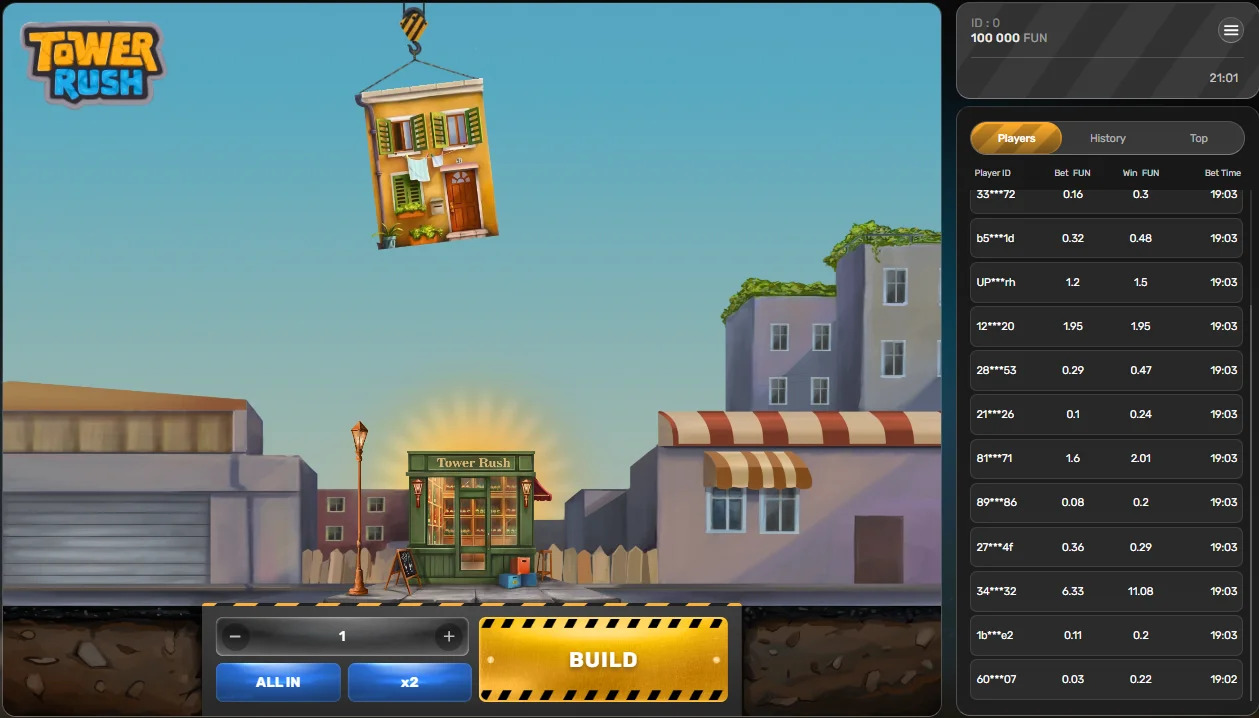
Tower Rush repose sur une seule tension. Chaque round commence à partir d'un terrain vide, et le bâtiment croît un niveau à la fois. Ajouter un niveau pousse le multiplicateur en hausse, et ajouter un niveau rend également plus probable que le suivant fasse tout s'effondrer.
Ce double effet transforme chaque moment en décision véritable. En bas, au premier niveau, peu a été gagné et le danger est à son plus bas. Plusieurs étages plus haut, le retour potentiel est plus important, tout comme la probabilité que la montée se solde par des décombres.
Lire un sens dans la hauteur est tentant. Une grande tour peut sembler due pour une chute, ou elle peut sembler bénie. Aucune de ces impressions ne reflète quoi que ce soit. Les résultats sont aléatoires, et la construction actuelle ne révèle rien sur le moment où elle cédera.
Cependant, la hauteur montre combien repose sur le round en ce moment. Tenir signifie plus à gagner et plus à perdre au même instant. Attendre n'est jamais un acte neutre ; c'est une acceptation délibérée d'un risque supplémentaire en échange d'une récompense supplémentaire.
People who enjoy Tower Rush over the long run tend to treat each new level as a short question whose answer they prepared earlier. Is this my number? Then bank it. If not, the climb goes on, and they know exactly what going on costs.
What a Tower Rush collapse means for the stake
A fall closes the round instantly. Should the building come down before you have collected, that round's wager disappears, together with the multiplier that had been building.
Nothing is paid for the levels already laid, and coming close to your target earns nothing either. The multiplier turns into money only when you bank it, so every figure shown before that moment is promise rather than payment.
The damage stops at that round's wager. Money banked earlier is untouched, and the following round begins again on a bare plot. Each fall is therefore a known, limited cost, which is precisely why your wager should only ever be a sum you could part with comfortably.
Special floors that change the decision
Tower Rush includes three special floors, which can emerge partway through a round. They are not part of every tower, nor can you summon one, yet their arrival can alter how you view the remainder of the climb.
| Floor | Effect | What it changes for the player |
|---|---|---|
| Frozen Floor | Secures the earnings already reached at its level | Some of the result is now safe, so carrying on becomes purely a question of whether the added multiplier justifies it |
| Temple Floor | Unusual level with its own multiplier pattern, which reshapes the climb | The normal level-by-level rise no longer holds in quite the same way, so check the rules before leaning on a preset target |
| Triple Build | Unusual level with its own multiplier pattern, which reshapes the climb | The climb unfolds differently from a standard level, so learn what it does in the version's rules before counting on it |
Of the three, the frozen one needs the least explanation. Once it has fixed the earnings at its height, a later fall in that round can no longer take them back. Some people use that moment to rethink their target; others stick to the plan they began with.
The other two are about movement rather than protection. Each pushes the multiplier along a distinct path, meaning the number does not advance the way it does on ordinary levels. Exact mechanics depend on which version the casino runs, so the in-game rules are where to read them.
No special floor can be foreseen. They appear under the same randomness as everything else, so a plan built on waiting for one is not a sound plan.
What helps is knowing beforehand how you would respond. If earnings get locked in, do you stop or keep climbing? If the multiplier starts behaving differently, does your number still make sense? Settling those questions before you play stops a special floor from turning into an excuse for improvisation.
Tower Rush by Galaxsys
Tower Rush is a Galaxsys creation, released in 2026. The studio placed it in the crash-style instant genre, in which a multiplier rises while the round lasts and the player has to collect before it ends without warning.
Its distinguishing idea is visual. Rather than an abstract graph, the multiplier is attached to a building raised one level at a time. Every new storey represents both progress and exposure, which makes the risk obvious at a single glance.
Galaxsys provides the game to online casinos, and each operator chooses how to configure it. That explains why certain details, such as the available wager span or the rules version installed, may differ between operators while the core mechanics stay identical.
The roles are worth keeping separate. Galaxsys builds the game. The casino hosts it, runs your account, processes payments and applies its own terms. Questions about deposits, limits or identity checks go to the casino, never to the studio.
RTP and rules of each version
Published figures underpin any honest decision, so it helps to know exactly where they come from and what they leave unanswered.
Return to player: Galaxsys publishes a range whose lower bound is 96.25% and upper bound 97.5%, the result depending on the version a casino chooses. The precise number for your game is printed in that version's rules. What the percentage covers: a theoretical return measured across an enormous volume of rounds. It predicts nothing about the next tower or one evening's play, both of which can end far from that figure in either direction. Where to find it: read the rules inside the game before your opening round at any casino you have not used before. The version's RTP, its special floor details and other key parameters are listed there. Volatility: the rules of every version spell out the volatility, and no single label covers every installation. Top multiplier and top payout: each version lists both in its rules, and they can vary from one installation to another. Wager span: no less than R 2, capped at R 2 000, subject to the casino's settings. Fairness claims: be cautious about outside statements on verification that the official rules do not confirm. Bonus money: when playing with casino bonus funds, the casino sets the conditions, including how far Tower Rush contributes to wagering, whether it is excluded altogether and any cap on the bet while the bonus runs. Practising decisions in the Tower Rush demo
Plenty of casino sites offer Tower Rush in a free mode funded by virtual credits. It is the most practical setting for rehearsing the decisions on this page before any real money is involved.
Testing a target is where it shines. Pick a number, run a batch of rounds, then tally how often the building gets there. Then raise the number and watch how the spread of outcomes shifts. The goal is not to uncover a winning figure, as none exists, but to sense how different levels of risk behave across many towers.
It is also an easy way to get comfortable with auto cash-out and to meet the special floors without consequence. Seeing Frozen Floor or Temple Floor appear in practice helps you decide calmly how you would treat it with real money.
Remember that play credits lack the weight of real money. Choices feel lighter when nothing is on the line, so use the free mode to learn the mechanics rather than as evidence of how you will act under pressure.
Tower Rush decisions on mobile and desktop
Tower Rush plays in the mobile browser of your phone or tablet, as well as on a desktop computer, with nothing to download. Opening it from the casino's games section is enough.
The decisions do not change with the device, but the conditions do. On a phone, a compact display and touch controls make it all the more important to settle the wager and target before a round begins. Auto cash-out earns its keep here, as it spares you from needing a perfectly timed tap.
A dependable connection matters everywhere. Short rounds leave little slack, so choose a spot with solid coverage rather than playing on a train or over patchy wifi.
Any app or file marketed as a Tower Rush download deserves suspicion. The game requires none, and unofficial installers are a familiar vehicle for malware and stolen logins.
Real-money Tower Rush at licensed casinos
Real-money Tower Rush is reserved for licensed online casinos with Galaxsys titles in their catalogue, and for players who are 18 or older.
The path is short. Register with an operator that holds a licence, complete its identity verification, make a deposit, then look for Tower Rush in the crash or instant category.
Before picking an operator, confirm that its licence is valid, that it accepts customers in your area, plus that its wager limits for this game match your budget. Unlicensed operators give no dependable protection for your funds or personal details.
Apply the same scepticism to anything offering an advantage. Prediction tools, bots, tip channels and so-called hacks have no way of seeing when a building will fall, since the result is random. At best they waste money; at worst they open the door to fraud.
Deciding when the session ends
The stopping point is the decision most often postponed until too late. Fixing it ahead of time protects your budget and keeps the game enjoyable.
Name a budget first. Choose the total you are ready to spend this session, and consider it gone the moment play begins. Once that sum runs out, play stops, with no reloading. Pick an end time. Rounds fly by, and an hour can vanish unnoticed. An alarm or a fixed finishing time stops a session from quietly stretching on. Pause often. Leaving the screen for a few minutes, even during a good run, refreshes your judgement and shows whether you are still sticking to the plan. Switch on the casino's tools. Licensed operators let you cap deposits and playing time, and many go further with cooling-off breaks and self-exclusion. Setting them up in your account turns good intentions into hard limits. Agree a loss threshold and a target for the session. Knowing which loss closes the session, and which gain would also send you away, guards against chasing losses or handing back a good result. Ask for help once the enjoyment fades. If gambling begins to bring stress, pressure or a need for secrecy, get support from people trained in gambling-related harm through a professional help service. Making that call early is far easier than leaving it.
None of this restricts the game. It is what lets Tower Rush stay a pastime rather than something that takes over your time and money.
Limits worth accepting
Certain facts cannot be engineered away, and acknowledging them sharpens every choice. RTP hinges on the installed version, so the only figure worth trusting is the one in the rules you have open. A fall costs that round's wager each time, however tall the building had grown.
Top payout and volatility likewise need checking in each version's rules, since they are not the same across installations. Above all, nothing guarantees a profit. Targets, wager sizes and timing routines influence how a session feels and how much you put at risk, but they leave untouched the randomness that settles every round.
Game details
| Category | Tower Rush |
|---|---|
| Developer | Galaxsys |
| Game type | Crash-style game |
| Max payout | 100× |
| Variance | Medium-High |
| RTP | 96.25–97.5% |
| Launch date | Jun 16, 2026 |
| Wager range | 0.1 - 100 |
Unique features
Arrêt automatique
Le mécanisme de retrait permet aux joueurs de sécuriser leurs gains à tout moment souhaité, évitant ainsi les pertes.
Niveaux de multiplicateur
Les niveaux de multiplicateur augmentent à mesure que la tour grandit, offrant des récompenses potentielles qui évoluent avec la hauteur atteinte.
Réglages de mise
Les joueurs peuvent ajuster leurs réglages de mise entre zéro point un et cent, permettant un gameplay flexible.
How the game works
- Comment régler votre mise — Commencez par placer votre mise souhaitée, qui détermine les enjeux de votre session de jeu actuelle.
- Comment choisir un multiplicateur — Ensuite, choisissez un multiplicateur cible qui reflète la hauteur que vous êtes prêt à atteindre avant de vous retirer.
- Comment fonctionne un tour — Enfin, surveillez le multiplicateur croissant et décidez quand vous retirer avant que la tour ne s'effondre.
Advantages and disadvantages
Avantages
- The game's medium to high volatility keeps players engaged with substantial risk and reward dynamics.
- The game's medium-high volatility offers potential for substantial wins, making gameplay engaging.
- Players appreciate the chance to win up to one hundred times their stake, enhancing the excitement.
- Accessible on various platforms ensures that players can enjoy Tower Rush wherever they are.
Inconvénients
- Some players might find the game’s quick rounds challenging for managing their bankroll effectively.
- The game's design may feel repetitive for those seeking varied gameplay experiences.
- Beginners might struggle with the pressure of deciding when to cash out, risking losses.
Play responsibly. The simulation uses imaginary currency — no cash rewards. For ages eighteen and over only. Ensure gaming laws are followed in your area.
Pensez-vous pouvoir battre la tour ?
Vous cherchez de l'aide ?
Le soutien est disponible de manière confidentielle et sans frais si le jeu cesse d'être agréable.
18+ seulement. Jouez de manière responsable. Les paris comportent des risques inhérents — pariez toujours dans vos limites.
Common queries
Un objectif plus élevé est-il toujours meilleur ?
No. A loftier target means the building must pass through more levels, each of which adds to the chance of a fall before you get paid.
Puis-je encaisser juste après le premier étage ?
Yes. Collecting is allowed at any point before a fall, including immediately after the opening level. The return there is small because the multiplier has barely moved, yet some newcomers bank that early on purpose to keep exposure minimal while they learn.
Le sol gelé change-t-il quand je devrais m'arrêter ?
It locks in the earnings reached at its level.
Des motifs peuvent-ils prédire un effondrement ?
No. Rounds are independent, and the timing of each fall is random. A run of early or late falls says nothing about the next tower, so any system that relies on spotting trends is built on an illusion.
La même mise est-elle requise chaque round ?
No. You may alter the wager between rounds anywhere inside the span the casino permits. A steady amount makes results easier to interpret, but changing it is up to you, ideally following a plan drawn up before play.
Does the demo behave like real play?
The free version runs the game using virtual credits.